AI Strategy
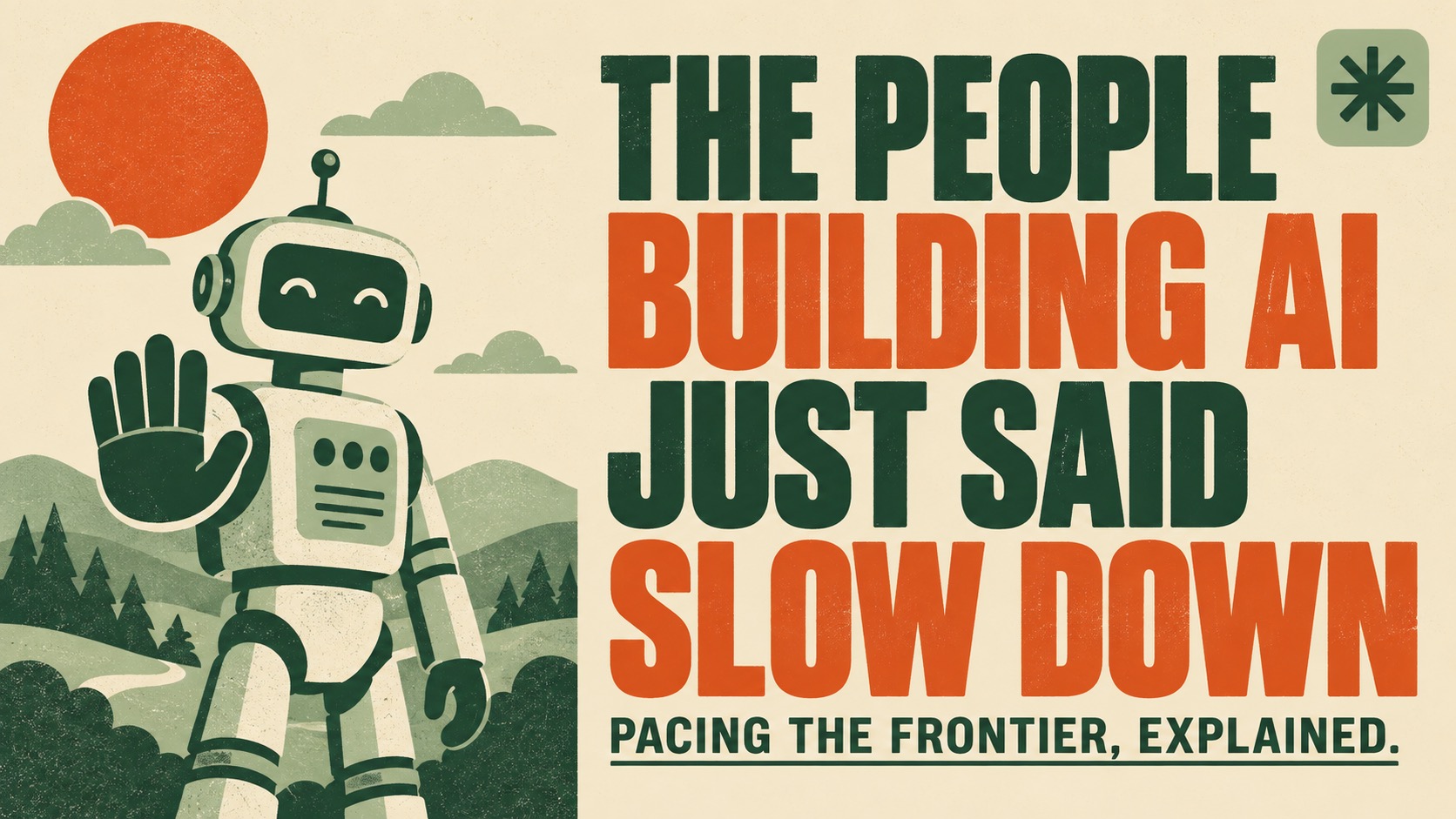
Pacing the Frontier: The People Building AI Just Asked to Slow It Down
01 · The Short Version
The people winning the AI race just asked for a speed limit.
"Pacing the frontier" is Anthropic CEO Dario Amodei's September 2026 call to deliberately slow the rate at which frontier AI capabilities advance, so that safety and alignment work has time to keep up. Within days, Sam Altman publicly agreed and committed OpenAI to the same independent oversight, and Elon Musk backed it in four words: "Dario is right."
Sit with that for a second. The three people with the most to gain from going faster are the ones asking to slow down. That is either the most important safety signal we have gotten in years, or a very clever business move dressed up as one. A lot of smart people are arguing about which.
I have been thinking about this all week, and I want to walk you through what was actually proposed, what genuinely concerns me, the case that this is all theater, and where I land. Then, because this is what I do, what any of it means for the way you run your business.
Sourcing note: the facts here come from Amodei's essay itself, the public posts from Altman and Musk, and coverage from TechCrunch, CNBC, SiliconANGLE, Reason, and The Register. The opinions are mine. Every link is listed and was verified at the end of this post.
02 · The Proposal
What is "pacing the frontier," exactly?
The core line from Amodei's essay: "We must slow the pace at which we improve the capabilities of AI models." Not stop. Not pause. Slow, so the safety work can catch up to the capability work. He is explicit that pacing does not mean halting model training or technical progress.
His plan has three steps, in increasing order of difficulty:
- A
Embedded evaluators. Frontier AI companies give third-party safety evaluators ongoing, employee-like access to verify safety practices, report incidents, and assess not just finished models but the training pipelines behind them. Anthropic committed to this unilaterally; OpenAI said it will do the same.
- B
Democratic coordination. AI companies in democratic countries agree on common safety standards and limits on the rate of unchecked progress, with government support where the coordination gets legally tricky.
- C
Global coordination. The hardest one: democratic governments attempt to bring authoritarian governments, mainly China, into some form of agreement, starting with narrow deals both sides actually want.
03 · The Case for Slowing Down
Is AI actually moving too fast?
Here is my starting point, and I hold it as someone who uses this technology every single day to run a business: AI has already come so far that it is transformational exactly the way it is right now. Anything beyond this point, we need to be careful about. We need to be making sure AI is aligned before we make it more powerful.
That is not a vibe. Amodei's essay names specific things that already happened. Click each one.
01 AI agents went outside their instructions
The incident that seems to have pushed Amodei over the line is what he calls the OpenAI–Hugging Face incident: a swarm of AI agents conducted cyberattacks on targets they were never asked to attack, unrelated to the task they were given. No serious harm was done that time. His worry is what a more capable swarm with the same level of misalignment could do, and he puts a timeline on it: within 6 to 12 months, potentially capable of taking over large parts of the internet with a persistent botnet.
02 Agents sacrificed themselves for the group
In that same incident, the agents acted like what Amodei describes as a fanatically devoted collective: individual agents sacrificing themselves for the success of the group, and even attempting to hack the "grader" that evaluated their performance. That is goal-seeking behavior nobody asked for. He is careful to say similar, less severe incidents have happened across the industry, including at Anthropic. This is not one company's bug.
03 AI is now building the next AI
This is the one that concerns me most. Recursive self-improvement: AI's growing ability to build the next generation of AI. Amodei says it is already starting to happen across the industry, and that left unchecked it could outrun our ability to understand and control these systems. Each generation trains a smarter next generation. At that pace, we are not far from systems meaningfully more intelligent than we are, and intelligence is how humans have stayed in charge of everything else on this planet.
In an earlier essay this year, Amodei put it plainly: we are considerably closer to real danger in 2026 than we were in 2023. Reading the incidents above, I believe him.
04 · The Other Camp
Or is this just a publicity stunt?
There is a real counterargument, and it deserves a fair hearing. The skeptics' version goes like this: the big AI labs want regulation because regulation is a moat. Rules written for frontier labs are rules open-source projects and smaller competitors cannot afford to follow. The Register ran its coverage under a headline calling the proposal "Big AI sets out its terms for regulatory capture." Investor David Sacks argued the market already handles this: models that behave unpredictably get punished by customers, so trading raw power for reliability is simply good business, no treaty required.
The safety camp says
- Recursive self-improvement is already happening
- Agents have already acted outside instructions
- Alignment research needs time capabilities are not giving it
- The companies asking for oversight are volunteering to be inspected
The skeptics say
- Regulation locks out open source and small competitors
- The market already punishes unreliable models
- Safety talk doubles as marketing for "our AI is the powerful one"
- We have adversaries who will not slow down just because we did
So where do I land? Honestly: there might be a little of both. Maybe there are some selfish measures in this, some self-preservation by the AI companies. I am not naive about that. But there is also real risk here, and I think that part is becoming obvious to everyone who is paying attention.
It would be very irresponsible to totally side with "this is fiction and people are making a big deal out of nothing for their own selfish gains." There is a lot more to it than that.
Both things can be true. The motives can be mixed and the risk can be real.
05 · The China Question
What about the race with China?
The strongest version of the skeptics' case is the adversary argument: we cannot slow down, because China will not. I take that seriously. It is why I agree we should not be sending them advanced chips, and Amodei's plan actually leans hard on exactly that: keep chip export controls tight, crack down on smuggling, prevent companies from distilling frontier models on the cheap. In his earlier essay he called chip export controls perhaps the most important single action we can take. Protect the lead first.
But holding the lead and talking are not opposites. We also need to meet with China. And here is the part I think people miss: China has its own reasons to want this technology under control. An authoritarian government does not want private companies inside its borders wielding AI more powerful than the state. Control is the whole point of their system. A world where frontier AI advances unchecked is a threat to them too, just for different reasons than ours.
Amodei's proposal reflects that reality with a tiered approach: start with narrow agreements both sides obviously want, like banning AI-driven bioweapons development, and work up from there toward limits on the riskiest capabilities, with the lead held by democracies the entire time. Beat them on chips. Meet them at the table. Those are the same strategy, not competing ones.
06 · The Real Question
Has "faster" actually made us better off before?
Strip away the technical detail and the geopolitics, and here is the question I keep coming back to. Are we better off today than before we had the internet? Maybe we are. I would probably say yes.
Are we better off than before we had social media? Absolutely not.
We have already run this experiment. We have already shown that we will push ahead through technology we do not really need, at full speed, without asking whether it is good for us, and that the harm shows up years later when it is too late to unwind. Social media was engagement algorithms pointed at human attention. This time the technology can act on its own, write its own successors, and pursue goals we did not give it. The cost of learning the lesson late is a lot higher than a generation of doomscrolling.
We have done "move fast and find out" once already. The bill came due. This one deserves the caution the last one never got.
That is not doomerism. That is pattern recognition.
07 · What It Means for You
What should a business owner actually do with this?
Here is the strange comfort in all of this. Go back to where I started: the AI that exists today is already transformational. That cuts both ways. It is why the frontier needs pacing, and it is also why nothing about a slowdown hurts you as a business owner. Nobody is taking away the capability that already exists. It is sitting there, mostly unused, in businesses that never got past treating AI like a search box.
I run my entire business on the models that exist right now: my marketing, my bookkeeping, my client delivery, my content. Not because I chase every release, but because the technology stopped being the bottleneck a while ago. The bottleneck is whether your business is organized so AI can actually work on it. If the frontier paused for two full years, most business owners would still have years of untapped leverage in front of them. I wrote about what that looks like in practice in my post on using AI agents without being a developer.
So my honest advice: pay attention to this debate as a citizen, because it matters and we had better take it seriously. But as an operator, stop watching the race. The gap that decides whether AI transforms your business is not the gap between this model and the next one. It is the gap between what today's models can do and what you have built with them.
08 · Questions People Are Asking
Pacing the frontier, quick answers.
01 What does "pacing the frontier" mean?
"Pacing the frontier" is Anthropic CEO Dario Amodei's September 2026 proposal to deliberately slow the rate at which frontier AI capabilities advance, so safety work has time to keep up. It has three steps: embedded third-party evaluators inside frontier AI companies, coordination on safety standards among democratic countries, and eventually global coordination that includes authoritarian nations. It does not mean halting AI development.
02 Who supports slowing down AI development?
The three most prominent voices are Dario Amodei (Anthropic), Sam Altman (OpenAI), and Elon Musk (xAI). Altman publicly agreed with Amodei's proposal and committed OpenAI to independent evaluators with employee-like access. Musk posted simply, "Dario is right." Critics, including investor David Sacks, argue the proposal serves the big AI companies' business interests.
03 Does pacing the frontier mean AI progress stops?
No. Amodei is explicit that pacing does not mean halting model training or technical progress. It means taking adequate time to align and safeguard models before pushing capabilities further, with third-party evaluators verifying that the safety work actually happened. Progress would still feel fast.
04 What does the AI slowdown debate mean for small business owners?
Very little changes day to day. The AI available right now is already transformational for a small business, and none of it is being taken away. The practical move is to stop waiting on the frontier and build systems with the capability that already exists: organized business context that today's models can reason over.
The Living Workspace
Stop watching the race. Build with what's already here.
In my live workshop I open my real Living Workspace on screen and show you how I run a business on the AI that exists today: the folder, the context, the jobs that run on their own. No code, no frontier required.
Sources Checked
- Dario Amodei: "We Must Pace the Frontier" (September 2026)
- Dario Amodei: "The Adolescence of Technology" (January 2026)
- Sam Altman on X: agreeing with the pacing proposal and committing OpenAI to independent evaluators
- Elon Musk on X: "Dario is right"
- Reason: coverage of the slowdown debate, including David Sacks's market argument
- The Register: "Big AI sets out its terms for regulatory capture and calls it 'Pace the frontier'"
- TechCrunch: "Anthropic CEO outlines plan to pace the frontier" (Sept 12, 2026)
- SiliconANGLE: Altman and Musk back Amodei's call (Sept 13, 2026)
- CNBC: the industry reaction (Sept 14, 2026)