AI Strategy
Do You Really Need Someone Else's AI Platform?
01 · The Short Version
The honest answer: probably not.
Right now you will see business coaches selling their own AI platform. You log in, you use their agents, you upload some of your business info. And to be fair, it is better than cold-chatting with a blank ChatGPT or Claude window, because at least it has some context about you.
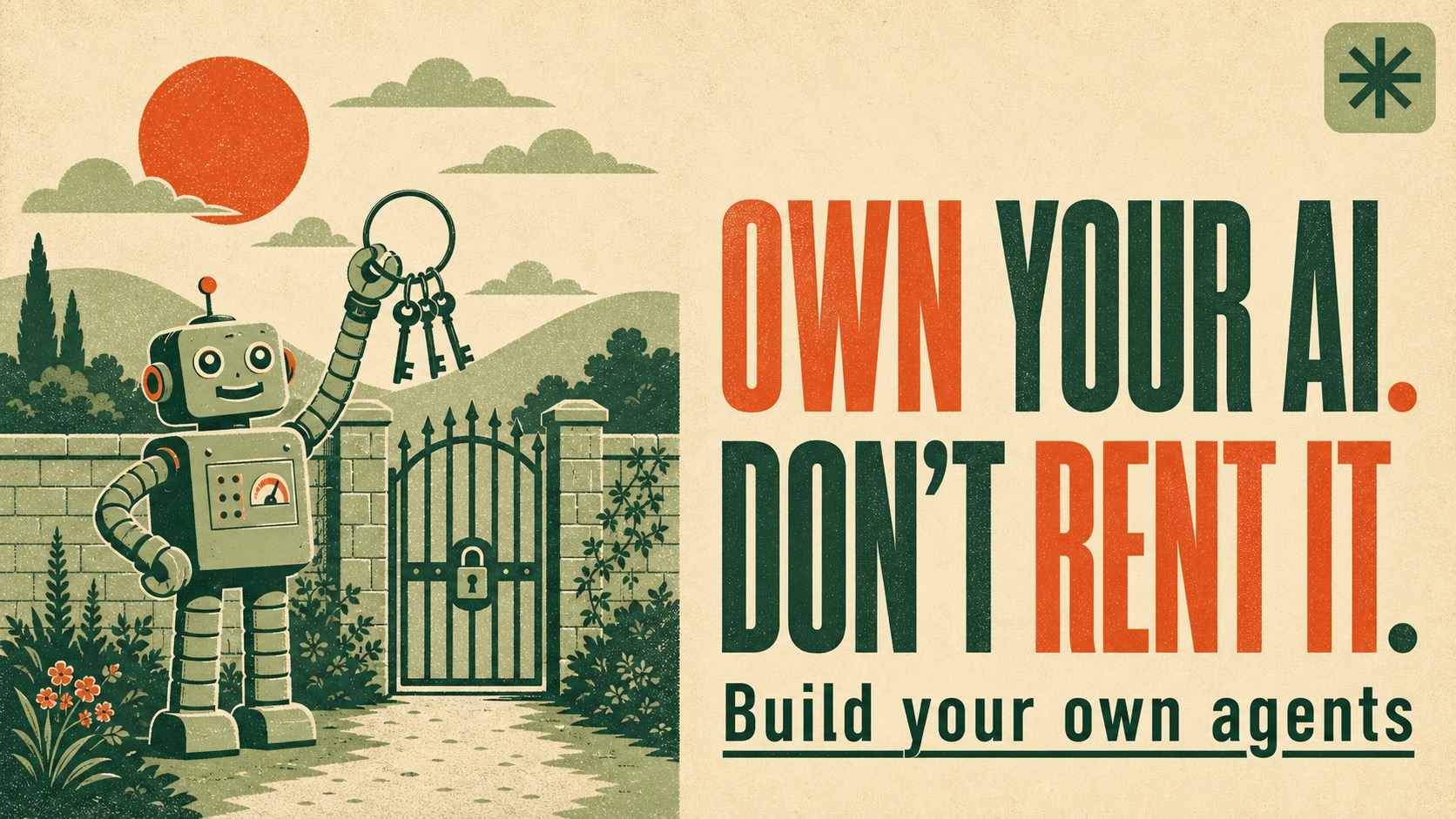
But do you really need someone else's AI platform? Probably not. When you build inside their app, you are renting capability you cannot change and do not keep. You can build the same architecture right inside Claude or Codex, own your living knowledge and your agentic workflows, and keep it portable.
Sourcing note: the capability facts below come from Anthropic's and OpenAI's own product documentation. The take on renting versus owning is mine, not a claim either company made.
02 · Give Credit Where It's Due
A coach's portal beats a blank chat box.
I want to be fair before I make the case against it. A packaged AI portal is a real step up from opening ChatGPT cold and re-explaining your business every single time.
Compared to raw, context-free chatting, a portal gives you:
- A
Pre-built agents so you are not staring at a blank prompt.
- B
Some of your business info already loaded, so answers are less generic.
- C
A guided path instead of "what do I even ask it?"
- D
A faster start on day one, with nothing to set up yourself.
That is genuinely useful, especially if you are new to AI. So this is not "portals are a scam." It is "a portal is the training-wheels version, and you can do better."
03 · What You Actually Give Up
Three things you are quietly betting on.
When you build your business on someone else's AI app, you are making three bets. None of them are in your control. Click each one.
You are betting they keep it current.
AI moves fast. New models ship, old ones get better, capabilities that were impossible last quarter become normal. Inside their app, you get the latest AI only when they decide to update, integrate, and ship it. If they get busy, distracted, or move on, your "AI platform" quietly ages while the actual models race ahead.
You are using agents you can't customize for your business.
Their agents are built for their average customer, not for your offer, your voice, your clients, and the specific way you work. You get what they decided everyone needs. You cannot rebuild an agent around your real workflow, add the one it is missing, or wire it to your own source material the way you would if it were yours.
You are trusting they set it all up securely.
Your business info and, potentially, your client information now sit inside a layer that a coach or a small team built on top of the models. You are trusting their setup, their permissions, and their data handling, mostly sight unseen. That is a lot of trust to hand to an app you do not control.
A portal makes you a tenant in your own business system. The moment the landlord stops maintaining it, you have nowhere to go.
And you can't take the walls with you.
04 · Here's the Thing
You don't need any of that.
Here is the part the portal pitch skips: you can build the right architecture right inside Claude or Codex yourself. Not a coding project. A setup project. You organize your business knowledge and you write instructions in plain English. The tools are built to be steered this way on purpose.
What you build
- Your business knowledge, organized as files you own
- Agents shaped around your offer and your workflow
- Repeatable workflows you can run again and again
- Instructions the AI reads every time, no re-briefing
What you skip
- Someone else's upgrade schedule
- Generic agents you can't change
- Blind trust in a stranger's security setup
- Your knowledge trapped in an app you can't leave
Both Claude and OpenAI's Codex are built so you can define an agent's role, hand it your own knowledge, and package repeatable workflows, without writing software. Claude does this with projects, custom instructions, knowledge files, and skills. Codex does it with skills and its own agent setup. You are describing what you want and giving it your material. The AI does the technical part.
What this looks like in practice: instead of logging into a coach's portal, you keep your offers, client notes, content library, and standard operating procedures in your own organized workspace, and your agents reason over that. When the models get smarter, your workspace gets smarter with them, automatically, because you were never depending on someone to re-wire an app.
05 · Ownership
Own your living knowledge and your workflows.
This is the whole difference. In a portal, your business memory is a feature of their product. In your own workspace, it is a set of files you control.
01 You can read and change everything
Your instructions, your knowledge, your workflows are yours to open, edit, and improve. No waiting for a feature request. No "that's not how the platform works." If it should work differently, you change it.
02 It gets smarter as the models get smarter
A better model dropped into a well-organized workspace is an instant upgrade, because it finally has something real to reason over. You are not waiting for a middleman to integrate it. You just start using the newer model against the same organized business memory.
03 Your client trust stays in your hands
You decide what goes in, where it lives, and who touches it. That is a very different posture than pasting sensitive material into a layer a third party built and hoping they got the security right.
04 You can walk away without losing it
Because the architecture is portable, you are never held hostage by one app's roadmap or pricing. If a tool stops serving you, your workspace comes with you.
06 · Interchangeable
The Living Workspace runs in Codex too.
Here is the point that undoes the whole "you need our platform" argument. The Living Workspace is the architecture, not the app. It is interchangeable. Your organized knowledge and your workflows are not welded to one company's product.
So yes, it runs in Codex too, not only Claude. That portability is the entire reason a portal is the weaker bet. A portal only works inside itself. When you own the architecture, you can move it to whatever tool is best, and you never have to rebuild your business from scratch to do it.
Don't build your business on rented land. Build the thing you can carry.
07 · So, Do You Need One?
A simple way to decide.
A portal is fine as training wheels while you learn what AI can even do. But if you are running a business you plan to keep, the math tilts fast toward owning it.
A portal might be fine if…
- You are brand new and just want to see what AI can do
- You want zero setup and don't mind renting
- You have no plans to customize anything
Build your own if…
- You want agents shaped around your business
- You want the latest AI without waiting on a middleman
- You want to own your knowledge and keep it portable
- You are building something you intend to run for years
You do not need someone else's AI platform to get the real benefit. You need the right architecture in a workspace you own. That is what I help people build.
G / Live Practitioner
Work With Me
Build the workspace you own, not the one you rent.
The Living Workspace Intensive is where we build your architecture together, inside Claude or Codex, shaped around your business, owned by you and portable across tools. No coding, no rented platform.